The Brief · Quick Read
Which GPT Model Should You Actually Use?
How do you choose a model without guessing?
Why this matters
Every few months the model list changes. A new name appears, an old one retires, and the question starts again: which one should I be using?
It is the wrong question. “Best” is not a property a model has on its own — it depends entirely on the task in front of you. A more useful question is much simpler to answer, and it keeps working after the menu changes.
Don’t ask which model is smartest. Ask which model is sufficient.
Default state · one visible choice

Advanced controls revealed · Model + Effort
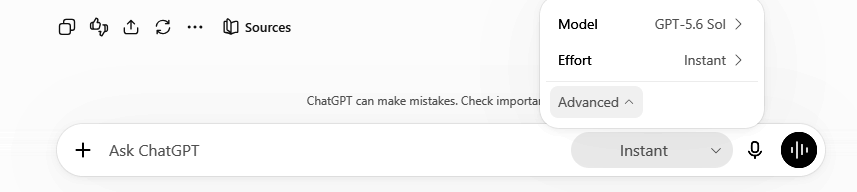
By default one selector is visible; the advanced controls reveal two separate choices — Model and Effort. Interfaces change, so treat this as what it looked like when captured, not a permanent layout.
ChatGPT desktop interface captured August 2026 · light mode
Big idea
CONCEPT DIAGRAM
Two decisions, not one
One task enters. Two independent controls shape the answer.
splits into two controls
Which model is answering?
governs
What kind of capability the task needs.
How much reasoning effort should it use?
governs
How much thinking the task justifies before it answers.
Both controls can change the result — but they are not the same decision.
Learn AI with Kelly
Kelly Hoxter-Hughes
Supporting insight
The first decision is capability: which model answers. The second is reasoning effort: how hard it thinks before it answers. Reaching for a more capable model and asking for more reasoning are different moves, and confusing them is why so much model advice feels contradictory.
Choose capability
Models are optimised for different kinds of work. They are alternatives, not a ladder — the fast one is not a worse version of the careful one.
REFERENCE MAP
Choosing capability
Three lanes for three kinds of work. Alternatives, not a ranking.
GPT-5.5
Fast general-purpose work
work it suits
- Everyday questions
- Drafting + rewriting
- Summaries
- Brainstorming
GPT-5.6 Sol
Complex professional work + reasoning
work it suits
- Analysis
- Research + synthesis
- Coding
- Planning
- Multi-step work
o3
Dedicated reasoning model
work it suits
- Logic-heavy problems
- Math / science reasoning
- Technical analysis
- Complex problem solving
o3 is scheduled to retire from ChatGPT on Aug. 26, 2026. Model availability may vary by plan and product — current as of August 2026.
Learn AI with Kelly
Kelly Hoxter-Hughes
Choose reasoning effort
Effort is about how much thinking the task deserves. Escalate when the work is complex, ambiguous, or built on several connected steps — not simply because the work feels important. And a short question is not automatically a low-effort one: fresh factual information may still need retrieval or search, whichever effort level you pick.
Reasoning-effort selector
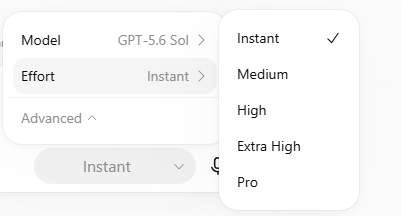
Five named levels, in one menu. The names may change; the decision they represent does not.
ChatGPT interface captured August 2026 · light mode
REFERENCE MAP
Choosing reasoning effort
Escalate with complexity and ambiguity — not with how important the work feels.
level
effort
use when · worked example
- E1Instant
The task is straightforward and the output you want is already clear.
“Rewrite this paragraph so it sounds less formal.”
- E2Medium
Several moving parts, and thinking through trade-offs helps.
“Compare these three project approaches and explain the trade-offs.”
- E3High
The answer depends on several connected steps, constraints or pieces of evidence.
“Evaluate these options against six business constraints and recommend an approach.”
- E4Extra High
Genuinely difficult or ambiguous — the reasoning is part of the deliverable.
“Analyse this architecture, identify failure points, then propose a redesign.”
- E5Pro
Exceptionally difficult work where extra capability is worth the wait.
“Build the strongest case against our own strategy, then rate each objection.”
This 1–5 scale is an educational decision aid, not a literal model or compute scale. Instant and Pro use different underlying models; Medium, High and Extra High vary reasoning effort on GPT-5.6 Sol.
Learn AI with Kelly
Kelly Hoxter-Hughes
Two things worth knowing about the top of the range. More reasoning is not a substitute for verification — the higher the consequence, the more review the output needs. And Pro is not simply “Extra High, but more”: Medium, High and Extra High vary reasoning effort on the same complex-work model, while Pro uses a higher-capability option intended for especially difficult tasks and longer-running workflows.
The framework, working
Task A — tidy up a customer email. One short piece of writing, you already know what you want, and a mistake costs a second read. Low complexity, low consequence: a fast general-purpose model at Instant effort is sufficient. Reaching higher adds waiting, not quality.
Task B — evaluate three suppliers against six constraints. Several moving parts, trade-offs that interact, and a decision the business will act on. The reasoning is the deliverable, so a model built for complex professional work at High effort is justified — and you still read the output critically before acting on it.
The lesson is not “use the strongest model for important work.” It is that capability and reasoning should be justified by the task and by the cost of getting it wrong.
What changes the economics
Four things move the answer, whatever the model names happen to be:
- Frequency and volume — a choice you make once is not the same as a choice made ten thousand times a day.
- Latency sensitivity — more reasoning takes longer, and sometimes the wait is the whole problem.
- Cost — capability and reasoning are never free, they are just charged differently.
- Consequence — the cost of being wrong is what justifies spending more capability, and what raises the need for human review.
Those last two behave very differently depending on where you are working. For an individual using ChatGPT, the economics show up as a subscription and usage limits: the practical cost of choosing more effort is mostly your own time waiting. For a system calling an API, every request is metered, reasoning consumes additional tokens, and a choice that is trivially affordable once becomes a real budget line at scale.
Prices, limits, model names and credit systems all change. Keep the mental model, not the numbers.
The product isn’t the model
One more distinction worth holding: the product you are using — ChatGPT, Microsoft Copilot, GitHub Copilot, Codex — is not the same thing as the model underneath it. Different products expose different models, tools, controls and configurations. Two people can be working with the same model and still get different results, because the instructions, context, tools, memory and permissions around it differ.
That is why the product is a step in the sequence, not a footnote: it decides which capability and effort controls you actually have to choose from.
Key takeaway
Run the same short sequence every time, in this order:
PROCESS
The decision habit
Five steps, same order, every time — whatever the menu looks like.
- 01Task
What am I actually trying to accomplish?
- 02Product
Which product am I working in, and what does it expose?
- 03Model
What capability does this need?
- 04Effort
How much reasoning does it deserve?
- 05Review
What happens if the answer is wrong?
Start with the task. Then choose the capability and the effort it deserves.
Model names and product configurations will keep changing. The order of these five questions shouldn’t have to.
Learn AI with Kelly
Kelly Hoxter-Hughes
Don’t just ask which model is smartest. Ask which model is sufficient.
Model names will keep changing. Knowing how to choose shouldn’t have to.
Take it with you
Save the model-selection reference guide.
A one-page reference you can keep beside you: the two decisions, the model alternatives, and the five levels of reasoning effort.
Get the model-selection reference guideFrom AI, Actually.
A practical Quick Read designed to help business professionals and small business owners make better decisions about the AI tools they already use.
Browse Learn AI with Kelly →